Things To Do near Heltor Rock

Ingra Tor, Princetown, Dartmoor National Park (approx. 18 miles away)
The Princetown Railway (Princetown to Yelverton Railway Dismantled) descends from Princetown to the border of Dartmoor National Park. All that remains is an old trackbed that's used for the Granite and Gears Princetown Railway Cycling Routes. The railway trackbed sweeps around a number of...

Drizzle Combe Settlements, Sheepstor, Dartmoor National Park (approx. 18 miles away)
Look at the Upper Plym Valley area (follow the River Plym upstream from Cadover Bridge to Plym Head) on the Ordnance Survey Explorer OL28 'Dartmoor' map and you'll see a high number of settlements. By Drizzle Combe, there are the remains of a large settlement at Whittenknowles Rocks a...

Ditsworthy Warren, Sheepstor, Dartmoor National Park (approx. 18 miles away)
Study a map of Dartmoor and you'll see plenty of names with the word 'warren' in them. Perhaps the most well-known example is Headland Warren by The Warren House Inn in the heart of the National Park. Another is Ditsworthy Warren in the Upper Plym Valley in the southern section of Dartmoor. Warre...

Vixen Tor, Merrivale, Dartmoor National Park (approx. 18 miles away)
'No admittance. Vixen Tor is private land and closed to the general public. Please do not trespass.'

Piles Valley Weir, Harford, Dartmoor National Park (approx. 18 miles away)
We include Piles Valley Weir as a point of reference. It's at the northern end of a track/road that runs up the wetsern side of the River Erme in Piles Valley. The track/road provides decent walking access to Dartmoor's south moor and is one of the routes you can take to see the longest stone row on...
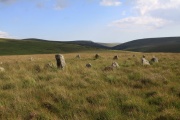
Stall Moor, Cornwood, Dartmoor National Park (approx. 18 miles away)
The River Erme and River Yealm rise on Dartmoor's south moor. They flow south to the border of the national park. Between them is Stall Moor. The terrain is difficult and boggy but the moor is peppered with amazing attractions from the world's longest stone row to a stunning waterfall. Stall Moor is...

Yealm Head, Cornwood, Dartmoor National Park (approx. 18 miles away)
The River Yealm rises, or begins, at Yealm Head. Yealm Head is situated on the southern side of a vast, flat and boggy stretch of moorland called Langcombe Hill. You don't find many people up there. If you have an urge to go, we'd recommend walking after a long period of dry weather or after extreme...

Drizzle Combe Stone Rows, Sheepstor, Dartmoor National Park (approx. 18 miles away)
In his superb 'The Field Archaeoogy of Dartmoor', Phil Newman writes: 'The majority of menhirs are associated with stone rows, forming the terminals at one end of the row. These may have existed before the rows were added or were erected as a deliberate element of the row. The three stone rows at...

Harford Moor, Harford, Dartmoor National Park (approx. 18 miles away)
Harford is a small village on the edge of Dartmoor's south moor. Harford Bridge spans the River Erme. The moorland east of the River Erme is called Harford Moor and is marked on the Ordnance Survey Explorer OL28 'Dartmoor' map by Piles Copse. We've positioned Harford Moor on Google maps so zoom i...

Drizzle Combe Giant's Basin, Sheepstor, Dartmoor National Park (approx. 18 miles away)
In 'High Dartmoor', Eric Hemery wrote: 'The huge despoiled cairn near the barrow heading the southernmost row is known as Giants Basin [sic]; Bill Pengelly told me that many of its stones were taken by Ditsworthy warreners for constructing their rabbit-buries.'

River Erme, Dartmoor, Dartmoor National Park (approx. 18 miles away)
Burgh Island, Bigbury-on-Sea Beach and Bantham Beach are among the most famous natural attractions on the South Devon coast. The River Avon flows into the sea here. Just north west is an equally beautiful but less well-known estuary called the Erme Estuary. The River Erme flows into the sea here....

Piles Valley, Harford, Dartmoor National Park (approx. 18 miles away)
Home to one of Dartmoor's rare high altitude oak woodlands, Piles Valley is cut by the River Erme as it flows from Dartmoor's south moor down to the South Devon coast. Marked on the Harvey British Mountain Map 'Dartmoor' map, Piles Valley is a stunning place. High above to the west is Stalldown Barr...

Lydford The Castle Inn, Lydford, Dartmoor National Park (approx. 18 miles away)
Beautiful village packed with visitor attractions Lydford is one of Dartmoor's best visitor destinations. Lydford The Castle Inn is situated in the heart of the village. It's a perfect place from which to explore the west section of Dartmoor. Things to do around Lydford The Cast...

Drizzle Combe Standing Stones, Sheepstor, Dartmoor National Park (approx. 18 miles away)
Dartmoor National Park is home to the highest point in southern England, the longest stone row in the world and the most remote spot in the Westcountry. It's also where you'll find a high number of standing stones or menhirs. The tallest, at over 3 metres, is at Drizzle Combe. One of three...

Lydford Castle (English Heritage), Lydford, Dartmoor National Park (approx. 18 miles away)
Lydford Castle is an English Heritage property at the heart of a beautiful and historically important village on the western border of Dartmoor National Park. According to English Heritage, 'Lydford Castle was probably built about 1195 to serve as a prison'. During the medieval period, conditions at...